

Parenting is an incredibly rewarding and challenging experience.
At times, it can feel like a real roller coaster of emotions – particularly if your child or young person is behaving in ways that feel difficult to manage or understand.
If your child’s behaviour is challenging at the moment, it might feel exhausting. But things can change. With support, both of you can experience a more positive family life. On this page, we’ve got lots of ideas and strategies to help you deal with difficult moments.
What is challenging behaviour?
Most children and young people will behave in challenging ways at some point. Feeling upset, angry, stressed or disappointed is a normal part of life. Because we develop our ability to manage our emotions as we grow up, children and young people do sometimes act out when they’re going through big feelings. In response to their emotions, they may display a range of behaviours. It’s normal for younger children to hit or 'have a tantrum’ sometimes. And it’s normal for teenagers to shout, lash out or storm out sometimes. Most children and teenagers will also push boundaries as they test their independence.
But sometimes, challenging behaviour can become more frequent and difficult to deal with. It may start to have an impact on someone’s day-to-day quality of life, on relationships and learning at school, and on other family members.
Examples of challenging behaviour include:
- having lots of angry outbursts or ‘tantrums’
- regularly shouting, swearing, hitting, biting or kicking
- kicking, hitting, smashing or damaging things in the home
- regularly refusing boundaries and routines, including not wanting to respond to reasonable requests
- being impulsive and taking physical risks
- blaming others for their behaviour
- bullying or being unkind towards others
- persistently getting into trouble at school
- refusing to engage in conversations about what’s going on
Why do children and young people behave in challenging ways?
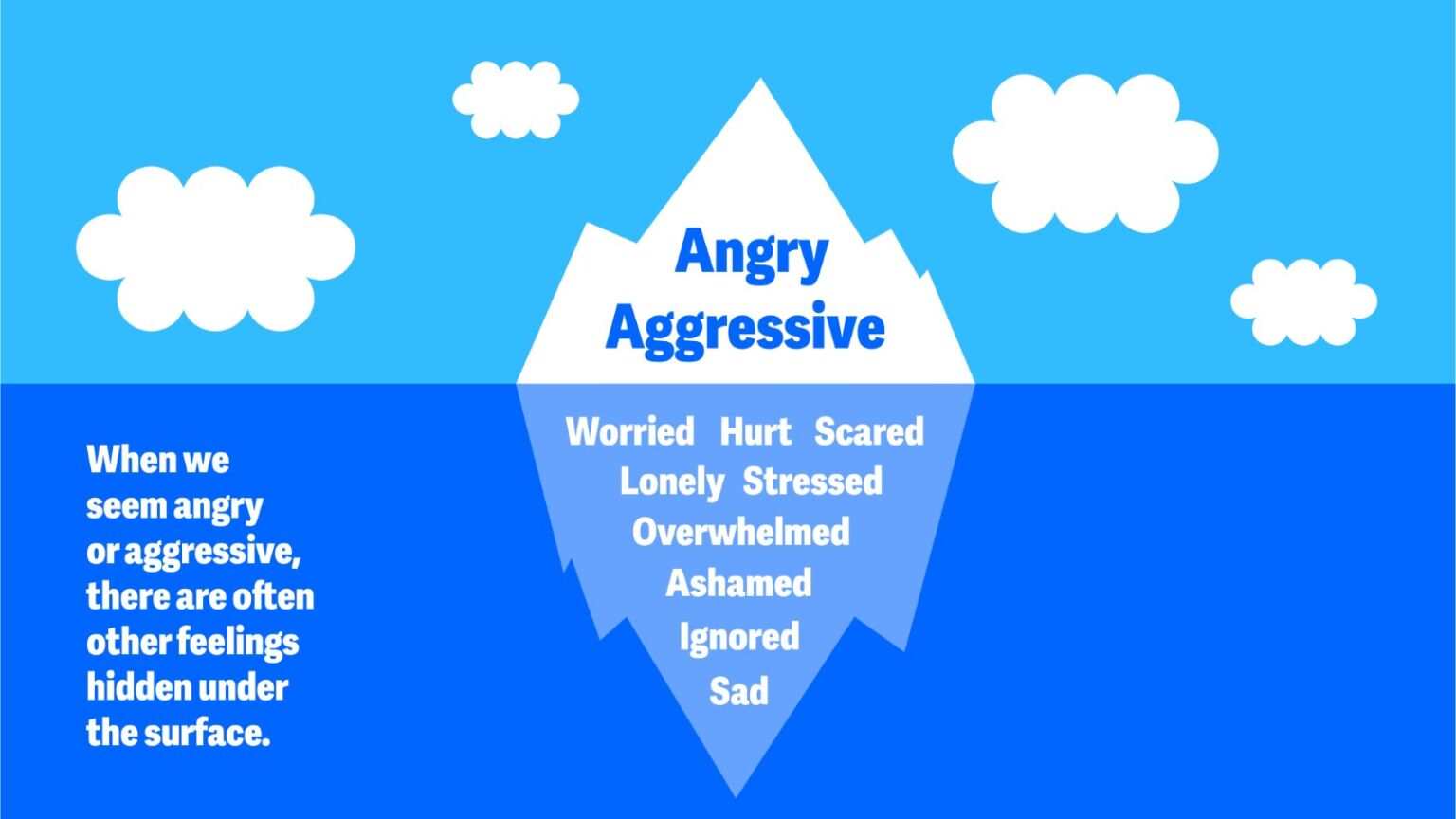
An iceberg submerged in water, with the text 'When we seem angry or aggressive, there are often other feelings hidden under the surface'. The words Angry and Aggressive are displayed on the section of the iceberg above the water, and the words Worried, Hurt, Scared, Lonely, Stressed, Overwhelmed, Ashamed, Ignored, Sad are displayed on the iceberg below the water.
The way your child behaves is a communication about how they’re feeling.
When your child is acting out, it can be helpful to think about the image of an iceberg. We only see the top of an iceberg because most of it is underwater. Similarly, when your child is behaving in challenging ways, there will be feelings going on under the surface that you cannot see. Your child may not be aware of these feelings and may need your help to talk about them.
Underneath their behaviour, a child or young person may be feeling angry, tired, stressed, anxious, confused, hurt, jealous, bored or something else. Whatever's going on, try to remember that the behaviour you see on the surface is not the whole story.
Talking to your child about their behaviour
If your child is acting out, starting a conversation about what’s going on can often feel like the hardest bit. Your child might not want to talk, or they might find it hard to recognise that there is a problem.
Starting a conversation while doing an activity together is a good strategy to try. This can help your child to relax by making it feel like less of a ‘big chat’. Depending on your child’s age, you could go for a walk, cook or bake together, or do something creative like colouring. Or you could start a conversation while travelling somewhere together.
If your child cannot talk at the moment, you could start a conversation by text or write them a letter instead.
Whether you’re talking in-person or in another way, our tips below can help you to have a positive conversation with your child.
-
Use simple phrases
Try to use simple phrases such as:
- "I notice there is a lot of shouting happening."
- "I think something might be upsetting you."
- "I feel worried you’re not happy."
- "I need you to know you can talk to me about what’s going on."
-
Make it clear that the behaviour is the problem, not them or their feelings
Be specific about the behaviour you have noticed, without using labels or negative words such as ‘naughty’, ‘bad behaviour’ or ‘horrible’.
Tell your child that it’s normal to feel angry, frustrated or upset, but it’s not okay to express it in this way.
-
Explain why the behaviour is not okay
It's important for your child to understand why their behaviour is not okay. For example, you might say that while it’s normal to feel angry, it hurts other people when they hit, or it hurts your feelings when they shout at you.
-
Be curious, empathetic and non-judgmental
Try to understand things from their perspective. Let them know that it’s okay to feel however they feel, whether that’s sad, angry, worried or something else.
-
Reassure them
Reassure them that you love them and you want to help them feel happier and enjoy things again.
-
Read our guide to talking to your child
You can find more tips and advice for starting conversations in our guide to talking to your child about mental health.
Helping your child to manage their behaviour
Having some behaviour management strategies in mind can help you to feel more confident. Below are some things you can try to help your child manage their behaviour. Have a go at some different strategies until you find what works for you and your child. Be patient if new strategies do not seem to work straightaway. It often does take a bit of time for change to happen, and for your child to get used to things.
It's important to set clear boundaries and stick to them as much as you can. You could do this by creating a family agreement together. This can cover things like screen-time, family meals and times for getting up and going to bed.
Remembering to explain why can help – so rather than just shouting ‘sit down’ at the table, I try to let them know that I’d like them to sit down so we can enjoy eating and that we can go and play when we’ve finished.
Give a warning before giving the consequence. This allows your child an opportunity to change their behaviour. After the consequence has been given and your child has calmed down, chat together about what happened. Then ‘wipe the slate clean’ and find time for a positive interaction with them soon after.
Notice and encourage them when they show the kinds of positive behaviour you have asked for. Be specific about why you are praising them. For example, you might say, ‘thank you for letting me know you were feeling angry without hitting your brother’. Or, ‘thank you for putting your phone away when I asked you to, now we can eat together’.
Challenging behaviour is exhausting and demoralising. In our family it often leads to everyone feeling less positive and only picking out the negative behaviours, which is so hard not to do. When we notice that we have all gotten stuck in a negative rut, we make an effort to pick up on and name some positives, however small, and this helps us move through a difficult time.
Depending on their age, some of these strategies might help your child to calm down:
- drawing or painting
- doing something active like running or their favourite sport
- listening to music
- having some time alone
- reading a book
- writing
- cooking or baking
- making something out of playdough or Lego
Having a list of coping strategies will help them to build up a bank of tools they can use when they’re struggling.
The more we can express ourselves and feel understood, the less likely we are to act out. When you show interest in your child’s feelings, it helps them to understand their own emotions and find words to describe them. With a younger child, it can be helpful to wonder out loud about what’s going on. For example, you might say, ‘I wonder if you felt really disappointed when we could not go to the park this morning because you were looking forward to it’.
Reading stories together that talk about feelings has helped my child get used to the words – giving them a way to talk about positive and difficult things.
Help them think about the signs that let them know they might be about to ‘blow their top’. These might be ‘seeing red’, their heart beating fast, feeling hot, clenching their fists, breathing heavily or feeling restless. They can use these signs to alert them to the fact that they need to choose a strategy that helps them, or ask you for help.
It’s completely normal to feel frustrated, angry, overwhelmed or hurt when your child is behaving in challenging ways. But try not to react or argue back, as this will only escalate the situation.
If you feel yourself running out of patience and it is safe to do so, it’s okay to walk away for a few minutes to calm down. This is actually a positive strategy your child can learn from you when they see you doing it. After a particular incident, make sure both of you have some space before you try to talk about what has happened.
Try to set aside some time when you can be really present and give your child your full attention. Find things you can enjoy together such as going to the park, playing a board game, cooking something or watching a favourite film. This can help to build a more positive atmosphere and relationship between you.
Share your concerns with their teacher, form tutor, pastoral lead., head of year or SENCO. Ask them what they have noticed. How does your child behave at school? Is it similar or different to the way they behave at home? If your child’s teacher has found something that works, it may be helpful to try it at home to provide consistency.
Finding professional support for your child
A counsellor or therapist can support your child to understand and manage their feelings and behaviour. Counsellors working with younger children will usually do this through play and arts activities.
Have a look at our guide to counselling and therapy to find out how you can access services in your area.
Be open with the school about the challenges you are experiencing and ask them for advice. Lots of primary and secondary schools provide extra support like mentoring, pastoral check-ins, learning support, peer buddying, and clubs and activities.
Whether they are at primary or secondary school, you might have noticed that something at school is triggering your child’s behaviour. This could be their relationships with their peers, their schoolwork or learning, or the school environment. If this is the case, work with the school to address this. You can find information and advice to help you do this in our guide to school anxiety.
If you are worried that your child is behaving in challenging ways because they are struggling with their mental health, it’s a good idea to speak to a GP. If you have a younger child, you can speak to the GP yourself to get information and advice. If you have a teenager, you can encourage them to make an appointment or ask them to go to an appointment with you.
The GP can discuss what’s happening and make suggestions for what might help. They can also make a referral to the NHS mental health service for children and young people, called CAMHS.
You can find out more about how GPs can help in our guide to getting support from the GP.
Sometimes, children and young people behave in challenging ways when they have an additional need, neurodiverse condition, learning disability or developmental difficulty that has not been recognised. This can include dyslexia, dyspraxia, autism, ADHD, or difficulties hearing or speaking. In this situation, they may be acting out because their needs are not understood at home or school.
If you think your child might have an additional need, speak to your GP, or to your child’s teacher, pastoral lead or SENCO. They can make a referral for an assessment. It’s helpful to make a log of the behaviour you have noticed so that you can provide evidence when communicating with professionals.
If your child is diagnosed with an additional need, you can ask the professionals supporting them about parenting strategies that will best suit them.
Looking after yourself
Supporting a child who is behaving in challenging ways can be an exhausting task. If things are tough at the moment, don’t be hard on yourself or your abilities as a parent. While it’s normal to feel upset when your child is acting out, often it is not about you. Like us, children and young people take things out on those they feel closest to and safest with. So try not to take it personally. Keep doing the things that help you re-charge and ask for support when you need it.
You might also find it helpful to reach out to other parents. It can be very reassuring to hear what they are struggling with and how they handle difficult situations. They can also be someone who gets it when you need to talk.
You can connect with other parents by:
- reaching out to family and friends
- accessing peer and group parent support through Parenting Mental Health
- joining Facebook groups or other online groups
- setting up your own parent support group using our guide


Useful helplines and websites
While we take care to ensure that the organisations we signpost to provide high quality information and advice, we cannot take responsibility for any specific pieces of advice they may offer. We encourage parents and carers to always explore the website of a linked service or organisation to understand who they are and what support they offer before engaging with them.
-
YoungMinds Parents Helpline
We support parents and carers who are concerned about their child or young person's mental health. We can provide detailed information and advice, emotional support and signposting.
You can speak to us over the phone or chat to us online. When we’re closed, you can still leave us a message and we'll get back to you in 3-5 working days.
- Opening times:
- 9.30am-4pm on Mondays, Thursdays and Fridays; 9.30am-6pm on Tuesdays and Wednesdays
-
Family Lives
Emotional support, information, advice and guidance on any aspect of parenting and family life.
- Opening times:
- 9am - 9pm, Monday to Friday; 10am - 3pm at weekends
-
Family Line
Provides information and support around family issues, as well as longer-term help through Befrienders and Counsellors.
- Opening times:
- 9am - 9pm, Monday - Friday
-
Contact - For Parents
Provides support, information and advice for families with children with disabilities or other conditions including ADHD. Also runs family workshops and activities.
Free online chat service available.
- Opening times:
- 9:30am - 5pm, Monday - Friday
-
Children 1st Parentline
Support for families living in Scotland. You can call their helpline for parenting support and advice on any issue, including challenging behaviour, divorce and separation, stress, or money worries. You can also find lots of information on their website.
You can also speak to someone over web chat.
- Opening times:
- Monday - Friday, 9am - 9pm; Saturday - Sunday, 9am - 12 noon
-
One Parent Families Scotland
Provides support, information and advice for single parents in Scotland.
Online chat service available.
- Opening times:
- 9.30am - 4pm, Monday - Friday

This page was reviewed in July 2023.
It was created with parents and carers with lived experience of supporting their child or young person with challenging behaviour.
We will next review the page in 2026.
YoungMinds is a proud member of PIF TICK – the UK's quality mark for trusted health information.
Whether you love the page or think something is missing, we appreciate your feedback. It all helps us to support more young people with their mental health.
Please be aware that this form isn’t a mental health support service. If you are in crisis right now and want to talk to someone urgently, find out who to contact on our urgent help page.
At YoungMinds we take your privacy seriously. If you’d like to read more about how we keep the information we collect safe, take a look at our privacy policy.